I’m always looking for ways to be more productive. Always. With so many things to get done, I’ve been a long time subscriber to the getting things done philosophy. Over the last couple of years, I’ve been toying with a block system to better structure my work day. Last week, I put block days to work.
The Block
A block is a period of time. Blocks come in various sizes. 30-minute blocks. 20-minute blocks. One hour blocks. You decide.
The goal is to break up your work day into blocks. Then decide what you want to do in each block. That’s it. The theory is simple, but the execution is a little harder.
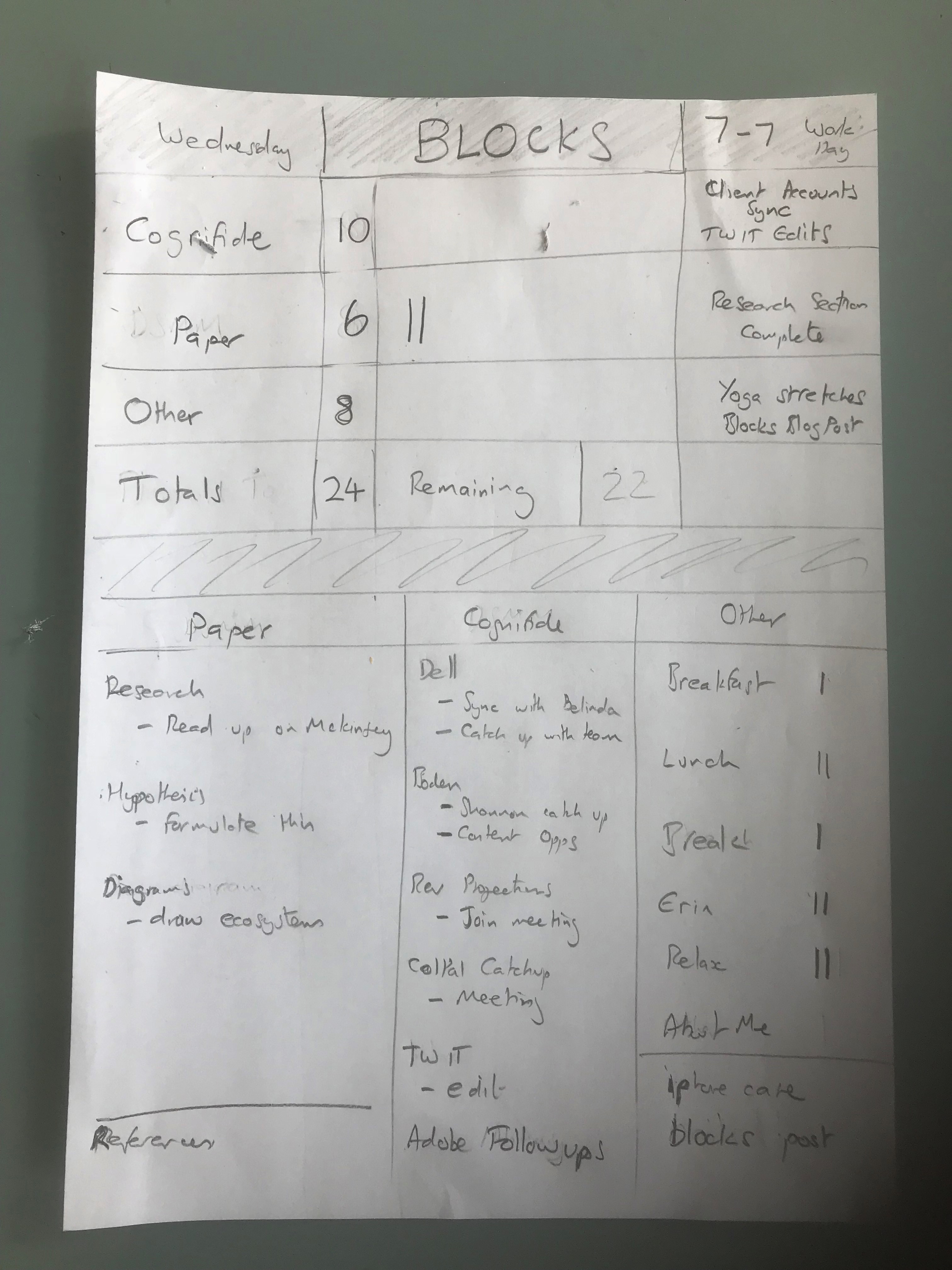 Time for an example. When I get up and decide its a block day, the first I do is grab a sheet of paper and block out the day. At the top, you see it’s Wednesday and my day runs from 7am to 7pm. I tend to use 30-minute blocks giving me 24 blocks in total to play with.
I work at Cognifide. I’ve assigned 10 blocks (5 hours) to Cognifide, a paper I’m writing has 6 blocks (3 hours) and other stuff I need to do in the day makes up the remaining 8 blocks (4 hours). I capture high-level outputs/outcomes for each of these block areas. For example, I want to complete the research section of a paper I’m writing today using the allocated 6 blocks. When I’m planning the block day, I make I’ll be happy with the outcomes/outputs. Then the day is around doing the activities in the blocks to hit those goals.
When I first started blocking out my day I got too fine grained. I had lots of block areas on the left, typically 2-4 blocks, but that didn’t work. So I got more coarse-grained in my planning. I introduced the bottom section to illustrate the activities I’d perform within each block area. This worked well. I tend to add and remove actions in this bottom section as I progress through the day. Always use pencils, and have an eraser nearby.
Finally, as you progress through your block day, mark the blocks off. This is so important. You are rewarding the progress you’re making. Marking off blocks is a great feeling and pushes you towards the end.
 Succeeding online used to be about launching web sites. Dot com and done! Fast forward twenty years and web sites are just one of many touch points competing for consumer attention. In addition to web sites, newsletters, catalogs, blogs, kiosks are also important assets within a brand’s overall owned media portfolio. Why owned? Because owned media assets are things directly controlled by the brand. Nobody else. However, owned media remains unclear and misunderstood by many. That’s not surprising given the messy, complex and overlapping relationship owned media has with other types of media, namely paid and earned. But what is becoming increasingly clear is the need to own your owned media to succeed online today. Let’s get a little deeper into this.