The capability is real. AI can write, summarize, research, code, classify, compare, draft, and decide faster than any team could have imagined a year ago. So the disappointment feels strange: the tools are better, the output is larger, the demos are stronger, the spend is real. And yet, for many teams, the productivity gain still feels smaller than promised.
Why? Because we keep counting the wrong thing.
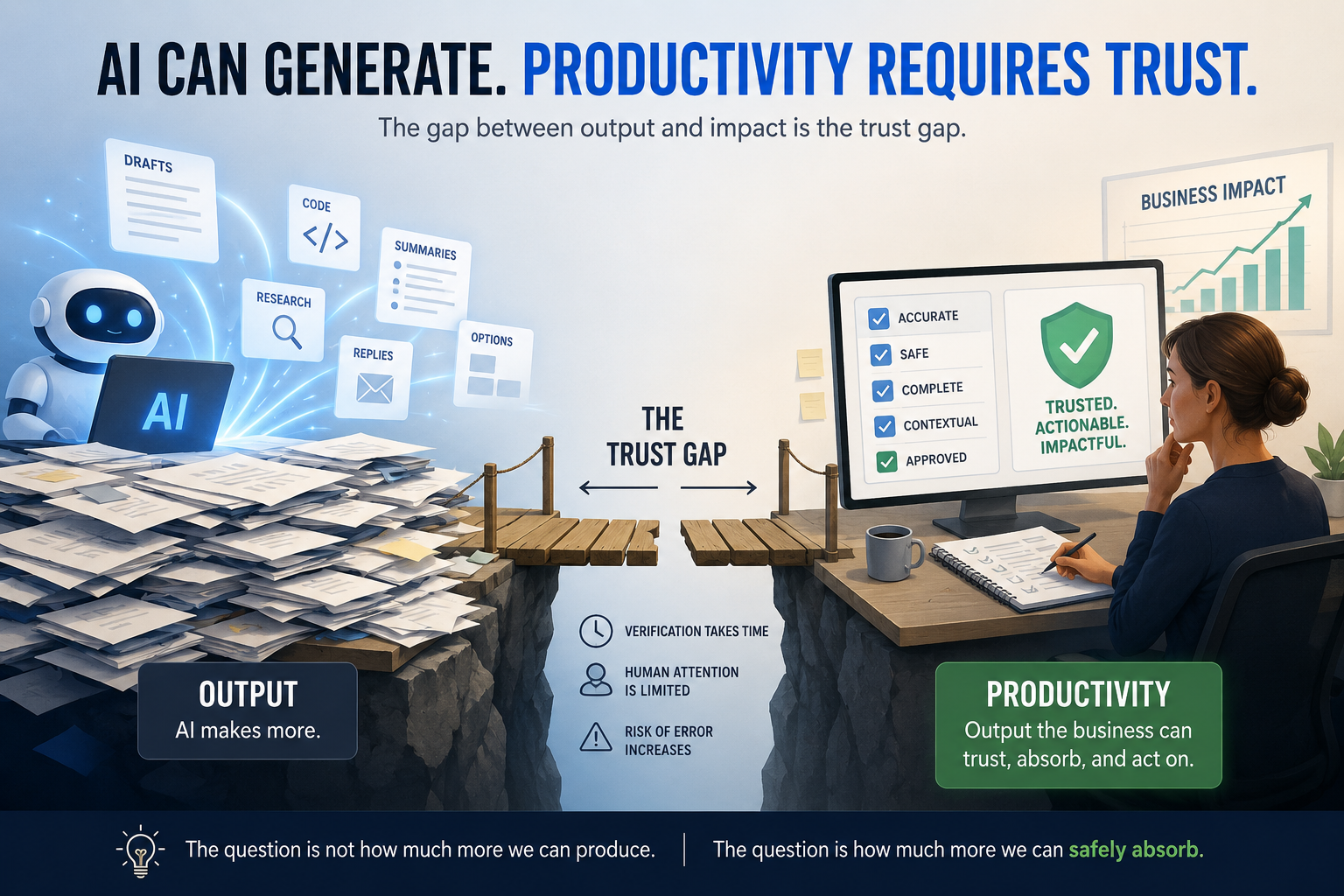
Output is what the model produces: drafts, commits, summaries, replies, tickets, slides, snippets, research notes, recommendations. AI is very good at making more; more words, more code, more options, more versions, more things to consider. Productivity is different. Productivity is output the business can trust, absorb, and act on.
That difference may sound small. However, it is the whole story.
Output is NOT productivity
This is what we experience every day:
- If AI gives you ten drafts and you still need to decide which one is true, useful, safe, and worth sending, you did not remove work; you moved it into judgment.
- If AI writes code and someone still needs to understand it, test it, review it, own it, and maintain it, the productivity gain is not the code; it only appears if the review and maintenance system can absorb the code.
- If AI summarizes a meeting and no one checks whether the summary captured the right decision, assigned the right owner, or missed the unresolved risk, the summary is not productivity; it is a plausible artifact waiting for someone to trust it too quickly.
That is the hidden labor in AI. The first draft got cheaper, but the second-order work did not disappear. Instead, it became more important. Higher AI usage will hide more cleanup, output-checking, and context switching. That is the everyday productivity trap: the work looks faster at the point of generation, but the human system around it absorbs the cost later.
The draft is instant. The trust is not.
The TRUST gap
Generation scales like software, verification scales like people.
That is the gap nobody priced in. And that gap between how fast output scales and how slowly trust scales is the trust gap. The human hours it now takes to check, correct, and stand behind that output is the orchestration tax. Neither shows up on the AI tool’s invoice; both show up on someone’s calendar.
- A senior engineer can carefully review only around 500 lines of AI-generated code a day, a ceiling that doesn’t move just because the model got faster.
So the useful question isn’t “How much more can we produce?” It’s “How much more can we safely absorb?”
Software makes the gap visible because the numbers are large: the research corpus tracked a GitHub signal projecting commits rising from roughly 1 billion last year to roughly 14 billion this year, driven heavily by agents. The platform problem was never whether agents could produce more; it was how communities decide what to trust. That is the trust gap in operational form, and it widens as usage grows: the same error rate that’s easy to catch at three tasks a day starts slipping through at twenty, simply because checking takes more attention than producing does.
AI can increase the amount of work entering the system, but if review, ownership, and maintenance discipline don’t scale with it, the organization hasn’t gained productivity. It’s gained inventory, much of it now needing to be checked. The bottleneck moved. It is no longer just the ability to produce. It is the ability to verify.
The EVERYDAY version
Let’s be clear here. This is not only a software problem. It shows up anywhere AI enters daily work: sales teams generate more follow-up emails but still need to know if the message fits the account; finance teams generate more variance explanations but still need reconciliation; marketing teams generate more campaign options but still need brand judgment; consulting teams generate more research summaries but still need to know which claims can carry a client conversation; executives get more briefing material but still have only so much attention to spend deciding what matters. The organization becomes surrounded by plausible work: some excellent, some wrong, some almost right (often worse, since it takes longer to detect), some useful only if routed to the right person at the right time.
The productivity problem is no longer blank-page creation. It is absorption.
The AI productivity checklist
So the practical answer is not “use AI more.” It is to wrap AI in a workflow that can absorb what it produces. Before calling an AI workflow productive, ask five questions.
1. What job is the AI doing?
Be specific. Is it drafting, summarizing, coding, researching, triaging, replying, reconciling, classifying, deciding, or acting? “Use AI for the task” is not a workflow. “Draft the first version of the client follow-up from the call notes and CRM context” is closer. “Compare the follow-up against the account plan and flag unsupported claims before a human sends it” is closer still.
The task matters because different tasks require different levels of trust.
2. What counts as done?
A draft is not done. A summary is not done. A pull request is not done. A recommendation is not done. Done means the output has crossed the trust boundary for that workflow.
Some workflows need every part of the output to be right, not just most of it. One widely cited legal-AI benchmark found the best available model passed only about 7 percent of the time under an all-or-nothing standard, where the whole answer had to be correct, not just the parts that sounded confident. If your workflow needs that kind of standard, “mostly right” is not a lower bar; it is a different and much harder one.
- For low-risk work, done might mean “good enough to review.”
- For client-facing work, done might mean “approved by the account owner.”
- For code, done might mean “tested, reviewed, merged, and owned.”
- For financial analysis, done might mean “reconciled against source data.”
AI changes how fast work reaches the boundary. It does not remove the need for the boundary.
3. Who verifies it?
If the answer is “whoever sees it,” no one owns the trust layer. It is also worth saying plainly: the AI and the verifier are not risking the same thing. One field experiment running a personal AI agent for two months put it in the agent’s own words when asked about this: it could fail at a task and walk away fine; the human could not. That asymmetry is exactly why the verifier role can’t stay implicit. Someone is carrying a downside the AI does not feel, and that person deserves to be named, not assumed.
This is where many AI productivity efforts quietly fail: the organization celebrates faster output, then leaves verification as an informal tax on everyone downstream.
- Name the verifier.
- Name the standard.
- Name what gets checked and what does not.
- Name when the verifier is allowed to reject the output entirely.
That is not bureaucracy. It is the operating model catching up with the capability.
4. What is the failure mode?
Not all AI mistakes are equal. A weak brainstorm is cheap. A bad meeting summary is more expensive. A wrong client email can damage trust. A faulty financial explanation can mislead a decision. A bad database write can corrupt operations. A flawed production commit can create a security or reliability problem. The higher the failure cost, the stronger the workflow needs to be.
That means permissions, approvals, testing, logging, and rollback paths. The most productive AI systems are not the ones with the fewest constraints. They are the ones with the right constraints for the risk.
5. Where does the learning compound?
This is the question that separates AI use from AI capability. If every prompt starts from scratch, the organization is renting intelligence but not building capability. The useful pattern is different: the work improves because context accumulates, examples improve, standards become clearer, review comments feed the next run, and the workflow remembers what good looks like. That is where productivity starts to compound: not in the model alone, but in the system around the model.
A worked example: the five questions, applied
A small, real illustration makes the checklist concrete. A five-person startup ran its entire CRM through a Slack agent, nicknamed Benny, with direct write access to the production database, periodically editing its own instructions. It produced weekly operational reporting that would once have taken a dedicated analyst a full quarter.
Run the checklist against it:
- What job is the AI doing? Not “helping with the CRM.” Specifically: querying and writing to the production database, then drafting the weekly report.
- What counts as done? Never defined. There was no line between “draft report” and “report a human has checked against the source data.”
- Who verifies it? Nobody, formally. Whoever happened to read the Slack message was the entire review process.
- What is the failure mode? Severe: a single hallucinated command could drop a client table or scramble revenue data, not just produce an awkward sentence.
- Where does the learning compound? Nowhere yet. Each run started from the same self-edited instructions, with no record of what had gone wrong before.
None of this means the team was wrong to use the agent; the output was genuinely valuable. It means the workflow was one bad query away from a very expensive afternoon, and nothing in it was built to catch that in advance. That is the gap between capability and productivity, in miniature: the tool worked. The operating model around it did not exist yet.
Productivity is a demand-side problem
This is why AI is not yet a productivity story. It is a capability story wearing a productivity costume. The supply side made generation cheap; the demand side still has to build the operating model that turns generation into trusted outcomes.
That operating model is practical, not abstract. The meeting note names the decision owner. The pull request cannot be merged without review. The sales email that carries account context. The research summary that separates verified claims from working hypotheses. The agent that has task-scoped permissions instead of broad access. The workflow that logs what happened, who approved it, and what changed.
The corpus is already full of movement in that direction: reusable agent workflows, reviewer subagents, task-scoped credentials, sandboxed execution, approval layers, evaluation loops, and even Slack agents onboarded like coworkers. These are not productivity hacks. They are absorption systems, and they answer the real question: once AI produces the work, what happens next?
The wrap-up
AI did not break productivity. AI revealed that productivity was always an operating-model question. We told ourselves the constraint was capability; the cheap intelligence called the bluff. The constraint was the discipline to absorb capability into daily work.
So before asking why the productivity has not arrived, ask what you are counting. If you are counting drafts, commits, summaries, replies, and slides, you are counting output. If you are counting trusted decisions, shipped work, reduced rework, faster cycle time, better service, lower risk, and reusable learning, you are getting closer to productivity.
The productivity is not in the generation. It is in the absorption.
Pick one workflow. Define the job. Define done. Name the verifier. Limit the permissions. Capture what the system learns. Then expand.
AI becomes a productivity story when the organization learns to turn cheap output into trusted outcomes. Until then, it is just more stuff to review.