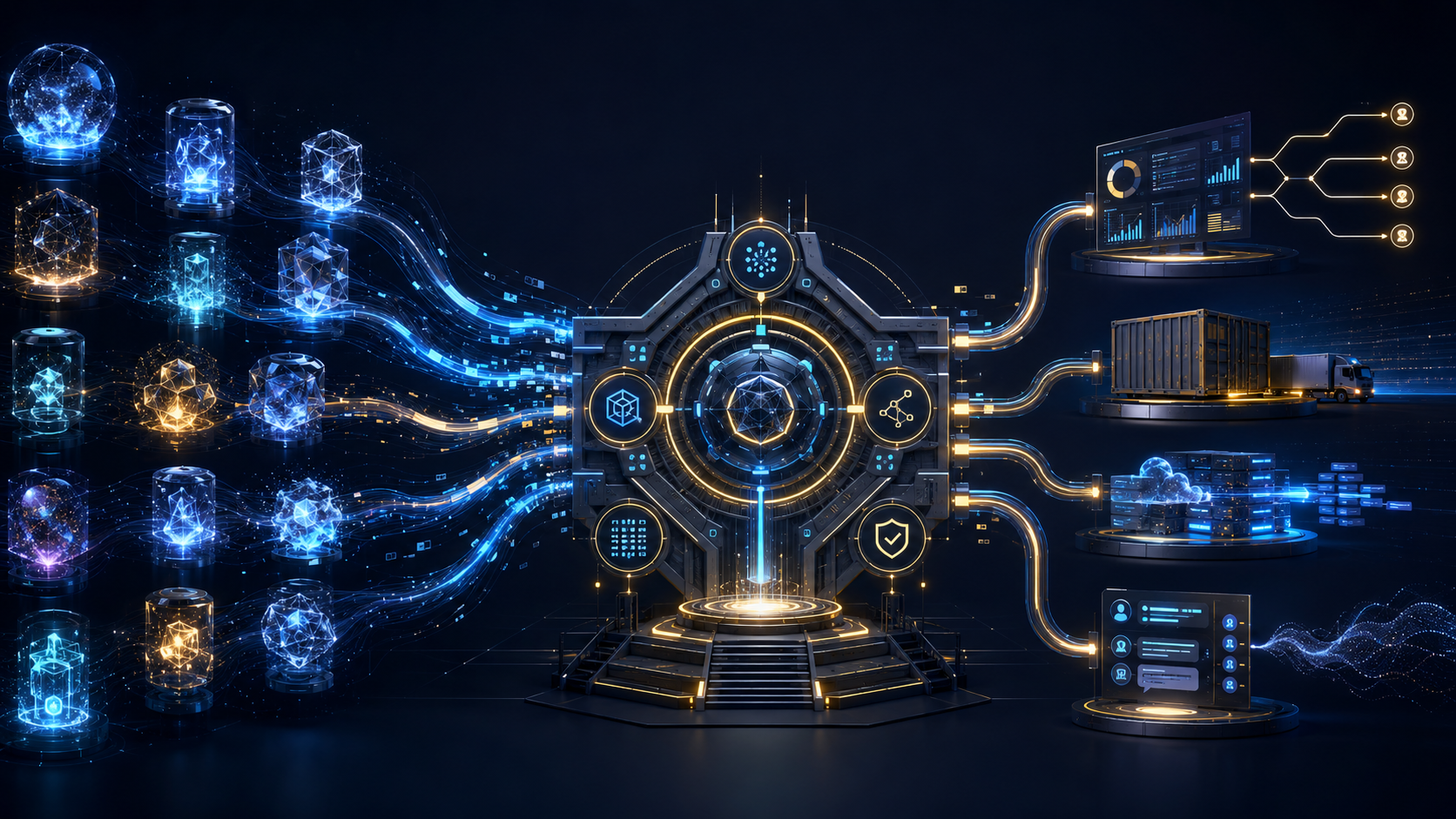
The race to build the smartest model isn’t over. However, for most businesses, winning it stopped being the point.
The model is becoming electricity
The frontier keeps advancing, and for a handful of hard problems, capability gaps still matter. But for most business work, capable models now come from four or five labs, at a fraction of last year’s price, swappable by changing a line of code.
When the thing everyone competed to own turns cheap and interchangeable, it stops being an advantage. It becomes a utility. Owning the utility is still a real business. Last I saw, electricity generation is a fine industry. However, it isn’t a differentiating one. You don’t build a defensible business on owning the current. You build it on what the current runs.
Sangeet Paul Choudary, in Reshuffle, puts a sharper point on this: AI used as a tool improves efficiency; AI used as an engine or coordination infrastructure changes the basis of competition. The model is the tool. The prize is whatever coordinates it.
Watch where the money actually moved
Two moves this month told the same story.
Stripe agreed to buy OpenRouter, the switchboard that routes requests across hundreds of AI models, for more than seven billion dollars. Stripe didn’t buy a model. It bought the layer that sits above all of them, routing and metering every call.
Days later, Cursor shipped Origin, its own code host, closing the loop from the first prompt a developer types to the moment code ships to production.
Different layers, same move. Neither company is betting on having the best model. Both are betting on owning the place where the work actually happens.
Find the merge gate
In software, a merge gate is the checkpoint where work is reviewed before it’s accepted into production. Every AI-touched workflow now has an equivalent: the point where an output becomes a decision, a shipment, or a customer commitment.
Choudary’s research gives that point a structure. Coordination power breaks into five parts:
- representation (who defines what the system can see)
- decision (who resolves what happens next)
- execution (who carries it out)
- composition (who sets the terms for plugging in)
- governance (who enforces the rules).
Whoever holds several of these at the point work gets approved holds the merge gate. Not because they built the best model, but because they built the system builder’s role around it.
Most leaders are still asking which model to build on. That question barely matters anymore, since the models are converging and the price is falling. The one worth your time: at the point where AI output becomes real in your industry, who holds representation, decision, execution, composition, or governance; and could it be you?
Before the stack sets
The window is open right now, but it won’t stay open. The stack is still forming; once it sets around someone else’s workflow, you’re renting your position from them.
Start with one workflow your customer depends on. Trace it from input to outcome, and mark where representation, decisions, and execution actually happen. That’s your shortlist of control points. Pick one, and build the system around it.
Own the merge gate, not the model.