Back Home

So, after a couple of years of writing for other blogs, which I will continue to do in earnest here and here, I’m coming back home.  No major changes. It will continue to be about the stuff I feel most passionate about:  digital content, technology and productivity. Why? Because I love writing.  I’m not great at it and I’m okay … Read more

What happened in 2011?

This year has been a little bit crazy. It’s mid November and I’ve called time on 2011. I need to slow down on the conference and seminar scene and try to digest some of the amazing things I’ve learnt listening, reading and watching great people in action.

It’s amazing to see different schools of thoughts appearing in content strategy, clients figuring out what mobile means for them, brand managers trying centralise and re-use digital assets, content producers proactively seeking better authoring experiences to make campaign management low(er) effort, and companies becoming more like publishers online. Times are definitely changing.

However, the real 2011 eye opener for me is that fact that consumers are digitally smarter than the companies trying to engage with them. I mean way ahead.

Meet Tom. He’s a 6th grade mobile app developer. He’s smarter than you and I, and his TED talk video has gone viral. So when trying to engage with folks like Tom online, the digital savvy consumer, to convince him we’re worthy of his time and (soon to be countless) digital dollars, companies are continually being caught with their pants down. Failing to understand social media. Delivering sub-standard customer experiences. Creating disconnected and impersonal user journeys. Exhibiting poor listening skills. The fact is you can’t hide from these digital disasters online. But when the likes of Dell, Burberry and John Lewis, to name a few, demonstrate that they are stepping up to the challenge, 2012 can’t come fast enough.

Consumers have definitely raised the experience bar and they expect all companies they do business with to get with the programme.
Read more

technology and content folks are still disconnected

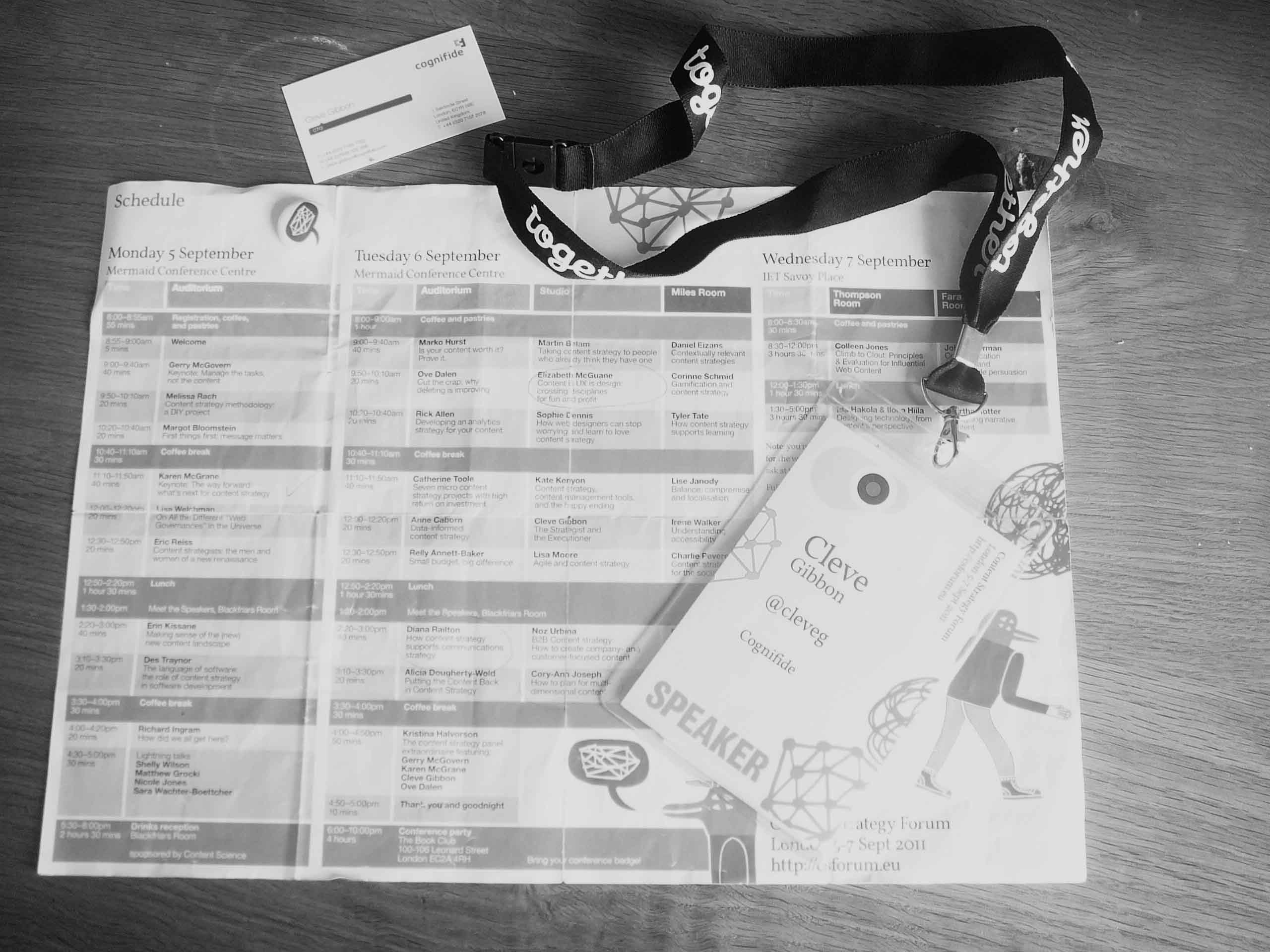
csforum11-badgeLast week at the Content Strategy Forum 2011 in London I gave a presentation on The Strategist and the Executioner. It was my first outing at a content strategy conference. I met some very smart people and got some great “in the corridor” insights from seasoned content strategists. I learnt lots.

I also found that content folks (strategists) and technologists (executioners) are still somewhat disconnected. The resulting gap has seemingly become an acceptable place to commit car crash content projects with all the usual excuses/finger pointing from both camps. We’re in a bit of a mess. However, my newcorridor content friends were acutely aware of these problem(s) and were full of ideas on how we can clean up the mess. However, as a group we seem to be failing to effectively execute on even the basic ideas. And so the CMS remains the problem of executioners and content the problem of strategists. We need to fix this!

Read more

What do content strategists do?

It’s a question being asked a lot these days.  By clients, the industry, fellow colleagues, creatives, technologists; the list goes on. So in June I attended an EConsultancy course on Digital Content Strategy delivered by Catherine Toole, CEO of Sticky Content to find out from a seasoned content strategist.  It was a great one-day overview that provoked a lot of lively discussion.  Then I got the slide that listed just some of the things a content strategist does.  Take a look:

brand strategy
messaging strategy
competitor content audit
format development
tone of voice
content style guide
copy deck
idea generation
editorial calendar
editorial strategy
SEO/PPC strategy
language guidelines
message map
content production schedule
terms of use
page tables
content licensing
sitemap
style guide
taxonomy
content approval workflow
migration strategy
content analysis
content audit
content inventory
content assessment
content gap analysis
content model
editorial workflow
content types
quality assurance tools
metadata strategy
cms architecture
content migration plan
metadata framework


Read more

Online CXM Solutions – CMS In The Middle

A recently published Forrester Wave report on Web Content Management for Online Customer Experience evaluates the strengths and weaknesses of some of the leading WCM vendors, observing that: The WCM market is growing rapidly to accommodate Customer Experience Management needs (CXM). The most effective way to do this is for WCM to integrate with a large array of CXM technologies. What … Read more

Low Effort increases Customer Loyalty

Back in July 2010, the Harvard Business Review (HBR) told businesses to Stop Trying to Delight Your Customers. HBR challenged conventional marketing wisdom and declared that satisfied customers are NOT loyal customers.

Delighting customers does not build loyalty. However, reducing the amount of effort required to get things done – does.  From a survey of more than 75,000 service-based personnel, HBR found that to really win customer loyalty forget the bells and whistles and just solve their problems.

Make it easy for your Internal Customers

These findings talk directly to the challenges faced by those managing content across multiple channels today. For example, below is a list of common problems internal customers encounter when trying to create and publish content:

  • The copywriter who struggles to edit an article.
  • The compliance officer who cannot preview content before it goes live.
  • The system administrator who cannot police the infrastructure.
  • The product manager who cannot change prices in real-time.
  • The brand manager who needs tighter control over digital assets.
  • The optimisation specialist trying to figure out cart abandonment issues.

Read more

Baked in Analytics

The old adage, you can’t control what you can’t measure, resonates loud and clear with marketers. If you don’t measure, you just don’t know, and businesses today cannot afford to be ignorant of their customer needs.

Technology has played a vital role in removing barriers to online measurement. Web analytics enable marketers to better measure and monitor digital campaigns. However, as marketing strives to reach more diverse audiences at the moments that most influence their decisions, the challenge is for businesses to have immediate access to ‘A’ class data (automated, accurate, aggregated, accessible, auditable, available) at every digital touchpoint along the consumer decision journey. That challenge is made even more difficult by the disconnect between those responsible for creating campaign content and those interested in measuring digital success. So what steps are being taken to close this gap?

Read more

What is a Marketing Technology Platform

Last month I gave a presentation on building a marketing technology platform. A few people have been in touch to share their ideas around customer engagement platforms and marketing automation. It comes as no surprise that there are numerous marketing technology platforms already in use today. But where are they and how are they being used?

What is a marketing technology platform?

Marketing technology are tools that make life simpler for marketers to market. They automate difficult, time-consuming and repetitive manual tasks to surface customer insight. Built by technologists, used by marketers. Marketing technology should aim to remove or significantly reduce the need for IT involvement. In short, to keep marketing in marketing.

Read more

Two marketing views of your website

Where do you think your website sits on the Web?

The folks over at Hubspot and have been quite vocal when advocating the benefits of inbound marketing over outbound marketing. They are not alone. Real-world marketing experiences reported by the Content Marketing Institute (CMI) demonstrate how companies that have embraced inbound marketing are enjoying greater digital successes with less investment. The CMI have also highlighted how marketing failures are being made by those organisations that do not understand the new conversation rules and/or the lay of the “social” land. But why?

Read more

Web Standard Template

A Web Standard is both a guide and a measure. I believe that Web Teams that invest enough time and the enough effort into Web Standards, will reap the benefits. We covered this in a previous post. Today, we dive straight in with a concrete example: URL Naming Web Standard. Note, just to keep this post to a reasonable length, I’ve had to trim it down. Rest assured it does have enough meat in there to illustrate what is a Web Standard.

Read more