AI has made the old transformation question sharper. If you run a mature company, do you keep repairing the legacy operating model or build an AI-native one beside it?
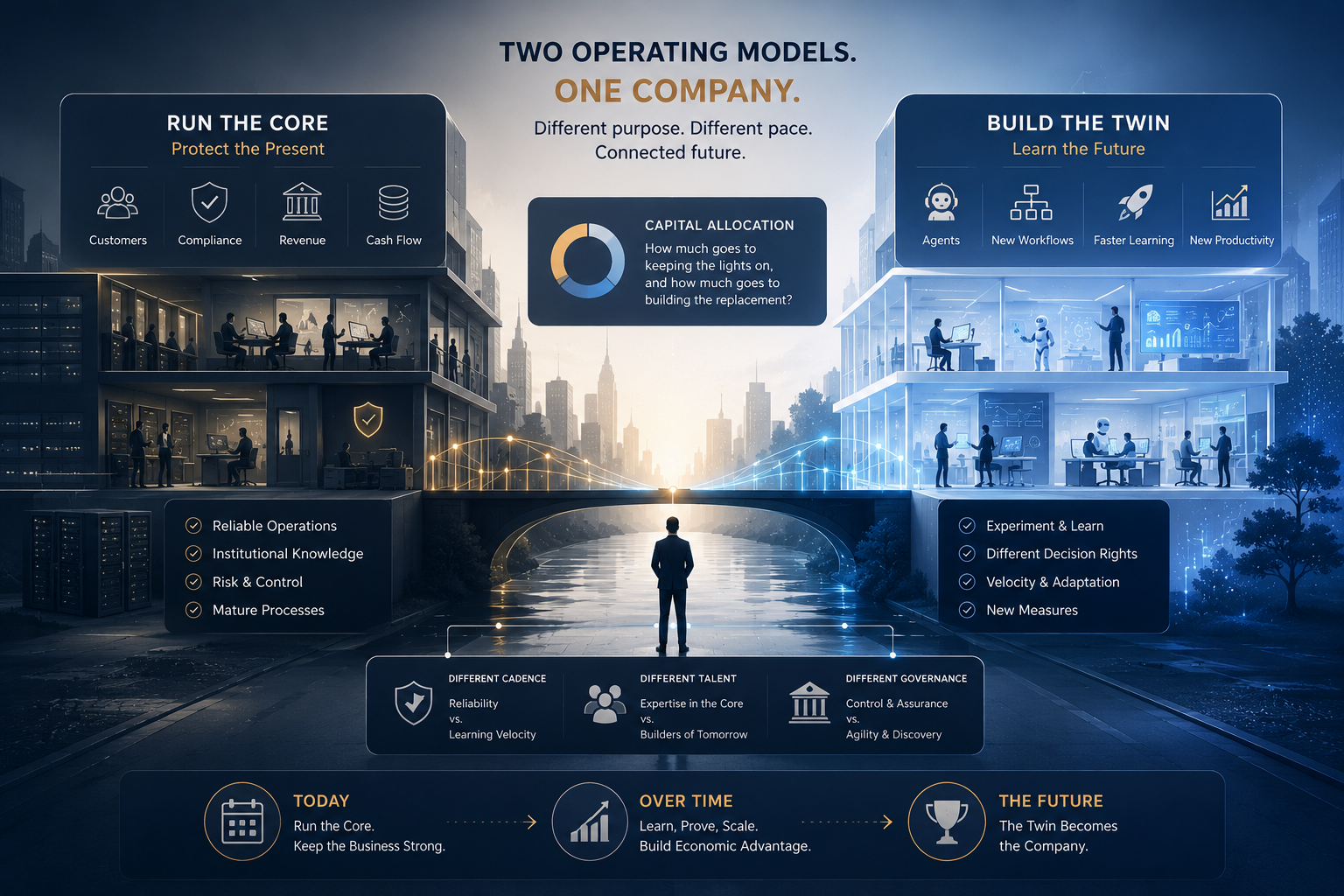
For most incumbents, the answer is not either/or. It is a transformation and a twin. One model keeps the business reliable, compliant, and profitable. The other learns how work should function when cheap intelligence, agents, and new workflows are native assumptions.
The legacy model protects the present. It carries customers, revenue, compliance obligations, institutional knowledge, and cash flow. It cannot be abandoned while the future is being built.
The AI-native twin learns the future. Some work is structurally different enough that retrofitting it into the legacy model slows learning. That work belongs in the twin: agents in the workflow, different decision rights, faster learning loops, and new measures of productivity.
The mistake is pretending one can do the other’s job. Legacy transformation protects today’s economics. The AI-native twin discovers tomorrow’s operating leverage.
Different cadence, different talent, different governance, same company. The legacy model needs reliability. The twin needs learning velocity. The leadership task is to connect them without forcing them to behave the same way.
The leadership question is capital allocation. How much goes to keeping the lights on, and how much goes to building the replacement?
Two operating models for one company are not duplication. It is a bridge. The end state is not two models forever. It is the moment when the twin has enough proof, maturity, and economic advantage to become the company.
Run the core. Build the twin. Decide, over time, which one deserves to become the company.