AI Enabled

If you haven’t read the note below from Micha Kaufman, CEO of Fiverr, to his team about AI coming for their jobs, you should. So do that, then come back here.

Done? Good. I agree with Micha. I’m a technology executive going through massive personal and professional change, and loving it. Personally, I’ve adapted to working with a team of machines that equip me with adjacent capabilities that were once inaccessible, too expensive, or unavailable. Professionally, they are a part of my everyday. So, what’s changed?

  1. I subscribe to OpenAI, Google, and Perplexity.
  2. I use Google Search less, and perplexity.ai more.
  3. I work in Google Docs for fast writing, cross-referencing to OpenAI via Canvas.
  4. I search in perplexity.ai, delegating to other models such as Claude, Gemini, and ChatGPT.
  5. I generate images through all the models.
  6. I draft plans, execute strategies, build hypotheses, analyze work, and summarize research.
  7. I develop code, launch applications, test systems, and validate thinking.
  8. I have shifted from information pulled from outside to insights pushed to me inside.
  9. I create a lot, but curate even more.
  10. I am always learning how to do things smarter.

In short, assume you can always get the answer. The challenge I’m finding is how do you ask better questions to shorten the distance between request and response. The ten things above help me ask the right question, within the right context, for the right outcome.

Fivrr @ Micha Kaufman 

Hey team,

I’ve always believed in radical candor and despise those who sugar-coat reality to avoid stating the unpleasant truth. The very basis for radical candor is care. You care enough about your friends and colleagues to tell them the truth because you want them to be able to understand it, grow, and succeed.

So here is the unpleasant truth: AI is coming for your jobs. Heck, it’s coming for my job too. This is a wake-up call.

It does not matter if you are a programmer, designer, product manager, data scientist, lawyer, customer support rep, salesperson, or a finance person – AI is coming for you.

You must understand that what was once considered ‘easy tasks’ will no longer exist; what was considered ‘hard tasks’ will be the new easy, and what was considered ‘impossible tasks’ will be the new hard. If you do not become an exceptional talent at what you do, a master, you will face the need for a career change in a matter of months. I am not trying to scare you. I am not talking about your job at Fiverr. I am talking about your ability to stay in your profession in the industry.

Are we all doomed? Not all of us, but those who will not wake up and understand the new reality fast, are, unfortunately, doomed.

What can we do? First of all, take a moment and let this sink in. Drink a glass of water. Scream hard in front of the mirror if it helps you. Now relax. Panic hasn’t solved problems for anyone. Let’s talk about what would help you become an exceptional talent in your field:

  1. Study, research, and master the latest AI solutions in your field. Try multiple solutions and figure out what gives you super-powers. By superpowers, I mean the ability to generate more outcomes per unit of time with better quality per delivery. Programmers: code (Cursor…). Customer support: tickets (Intercom Fin, SentiSum…), Lawyers: contracts (Lexis+ AI, Legora…), etc.
  2. Find the most knowledgeable people on our team who can help you become more familiar with the latest and greatest in AI.
  3. Time is the most valuable asset we have—if you’re working like it’s 2024, you’re doing it wrong! You are expected and needed to do more, faster, and more efficiently now.
  4. Become a prompt engineer. Google is dead. LLM and GenAI are the new basics, and if you’re not using them as experts, your value will decrease before you know what hit you.
  5. Get involved in making the organization more efficient using AI tools and technologies. It does not make sense to hire more people before we learn how to do more with what we have.
  6. Understand the company strategy well and contribute to helping it achieve its goals. Don’t wait to be invited to a meeting where we ask each participant for ideas – there will be no such meeting. Instead, pitch your ideas proactively.
  7. Stop waiting for the world or your place of work to hand you opportunities to learn and grow—create those opportunities yourself. I vow to help anyone who wants to help themselves.

If you don’t like what I wrote; If you think I’m full of shit, or just an asshole who’s trying to scare you – be my guest and disregard this message. I love all of you and wish you nothing but good things, but I honestly don’t think that a promising professional future awaits you if you disregard reality.

If, on the other hand, you understand deep inside that I’m right and want all of us to be on the winning side of history, join me in a conversation about where we go from here as a company and as individual professionals. We have a magnificent company and a bright future ahead of us. We just need to wake up and understand that it won’t be pretty or easy. It will be hard and demanding, but damn well worth it.

This message is food for thought. I have asked Shelly to free up time on my calendar in the next few weeks so that those of you who wish to sit with me and discuss our future can do so. I look forward to seeing you.

Yours,

Micha

GO BACK
Posted in AI | 1 Comment

Technology Storytelling

Pablo Picasso once said:

“The meaning of life is to find your gift. The purpose of life is to give it away.”

It can be difficult to give our gifts away in capitalist societies where we struggle to achieve economic security for our families. Regardless, we need to discover our gifts in order to decide how to provide for ourselves and others, whether that means selling our talents or giving them away.

When I was young, I thought my gift was long-distance running. This evolved into a passion for athletics, and then football. But then I discovered technology. As I learned more about myself, I found that I’m an extrovert in public settings and an introvert in private ones. In other words, I love to research independently and share my findings broadly in person. My ideal platform for sharing is on a stage or in a meeting. I dislike using other people’s material; I need to develop the story and tell it my way. My gift is storytelling—specifically, how technology evolves and impacts people and their environments. And those people could be employees, consumers, friends, family, or you!

Technology Storytelling

Technology storytelling

Technology storytelling is crucial. Our technological canvas is expanding, with more and more ways to color in between blurred lines. Storytelling gives technology purpose, establishes boundaries, and guides how we begin our journey with it. It clearly articulates where you are today, why things matter to you, where you could be, and your best next steps to get there.

I didn’t know it at the time, but my first career as a university lecturer revolved around storytelling. I taught computer science students about the application of technology within industry. My subsequent careers in the private sector allowed me to gain experience and expertise in doing just that. And guess what? 30 years later, technology storytelling remains essential—a gift that keeps on giving. There are so many ways to share it, even beyond the realm of technology. So I’m super excited about what’s to come.

Posted in Uncategorized | Leave a comment

From Obligation to Opportunity

Glass Half Full

We all know the oft-cited analogy of a glass half full versus half empty. In his book Atomic Habits, James Clear expands on this topic and explains how to put it into action.

When building a new habit, Clear discusses the subtle but important mindset shift of moving from obligation to opportunity. Here are a few everyday habits I’m building in 2024:

  • Do 100 push-ups before my morning coffee
  • Listen to a podcast
  • Help my wife with a chore
  • Read for 30 minutes
  • Write for 30 minutes
  • Practice Spanish for 5 minutes

But here’s the twist. Instead of feeling like I have to do these things, I tell myself I get to do them. I consider myself lucky to have the opportunity. And that’s the shift from obligation to opportunity—or seeing the glass as half full.

Oh, and by the way, I’m working up towards 100 push-ups…that’s a process.

Posted in Uncategorized | Leave a comment

Knowledge and Allocation Economies

We are using AI to enhance performance and improve decision-making.  The allocation economy suggests that knowledge workers will shift to managing AI tools that do more of the work rather than doing it themselves.  These AI tools are agents that have large language model (LLM) front ends to facilitate scaled interactions using plain language.  What does this mean for our knowledge and allocation economies?

knowledge and allocation

Many hands, light work

A recent study by Cornell researchers found that increasing the number of AI agents collaborating can significantly improve performance. Imagine a world where you’re compensated more for how well you can allocate intelligence, rather than having it.  People who can effectively allocate intelligent agents to improve outcomes will arguably perform better than those who can’t. 

In Knowledge lies power

Knowledge workers are rewarded for what they know. Thanks to internet-powered tools like Google, access to world knowledge is fully democratized.  Now AI is making sense of all this accessible knowledge to put accessible intelligence into the hands of the many.   

Think of AI as having your own personal research assistants to make sense of all the world’s accessible knowledge.  So if everyone has access to intelligence, we are all smarter. However, delivering real value is the result of good execution on a good idea.  

Allocation is key for good execution

The allocation economy is largely about execution.  How well can you assemble an execution pipeline with the intelligence and means to deliver on a good idea?  Imagine a world where you don’t need to find smart people.  Instead, you are manager of accessible intelligent resources, where successful outcomes rely upon your ability to right-size allocations. What kind of skills do you need to thrive in a world like this? 

Summary

An agentic workforce is a digital workforce infused with AI agents. Research highlights that organizations are getting smarter through sheer strength in numbers, and those numbers are through the addition of intelligence, or AI agents, to the digital workforce.  As compute power and abilities continue to scale, automating unlimited amounts of agents to complete tasks could lead to mind-blowing increases in capabilities. 

Posted in Uncategorized | Leave a comment

Stepping Stones to Intelligence

We are rapidly accelerating toward a world of intelligent systems. The stepping stones to intelligence are clear:

  • Data: It is the fuel, creating information from which we can glean insights and generate ideas.
  • Digitisation: Provides ubiquitous access to everything, everywhere.
  • Platforms: Facilitate scaled interactions between producers and consumers.
  • Language: Offers a common vocabulary for communication across the enterprise.
  • Intelligence for the Masses: Increases the amount of and access to intelligence.

Each of these stepping stones to intelligence represents a paradigm shift. They have been progressing rapidly and independently, converging toward an intelligence-powered future.

stepping stones to intelligence

Data

Data, derived from the Latin word datum, means something given. Brands enhance their experiences to increase customer interactions, collecting data as a result. This data is the fuel for future growth; the more you have, the greater your opportunities to monetize it.

Digitization

Digitization is the first D in Peter Diamandis’ 6D model of technological disruption leading to exponential growth. Digital data is easy to access, share, and distribute. It is the currency of the information economy, enabling digitization.

Platforms

Successful business platforms like Spotify, Airbnb, Uber, Netflix, and Amazon (SAUNA) drive massive value. They facilitate scaled interactions, exchanging units of value such as music, stays, rides, shows, and products. Enabled by the internet, platform businesses democratize access to digital data.

Language

The language of business is critical to success. It varies by sector, category, practice area, region, and specialization. For example, the language used in the US market for commerce to sell electric vehicles in the automotive sector. Making this language external for both humans and machines is a significant AI challenge.

Intelligence

The amount of and access to intelligence are increasing exponentially. Machine intelligence is rapidly surpassing human intelligence. Democratizing access to this intelligence across corporate and consumer landscapes opens limitless possibilities.

In Summary

Imagine an AI continent with 1 billion smart workers, paid in a few watts per day. They work tirelessly and only need instructions. These future digital workers are mobilizing today, marketed as copilots, agents, companions, and assistants. So, integrating them into blended teams or teams of teams is the next challenge.

Posted in platforms, intelligent | Leave a comment

Execution with AI

One of the fascinating aspects of language is the myriad ways to convey the same message. Different audiences require tailored messaging that resonates specifically with them. Today, the tech industry emphasizes that execution with AI is the future. However, let’s step back and consider a simple formula:

  • Value = Idea x Execution

Where:

  • Value is your desired output.
  • Idea is what will lead to that desired output.
  • Execution is how you bring your idea to life.

From this formula, here are a few key takeaways:

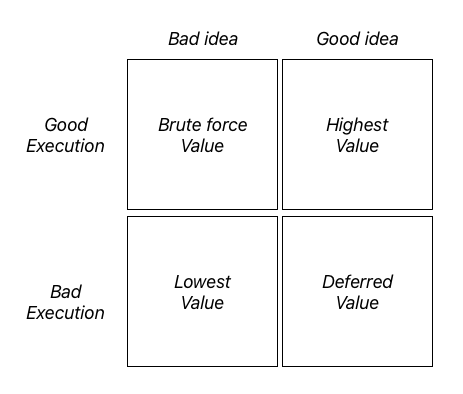
  1. A good idea multiplied by good execution drives significant value.
  2. Poor execution combined with a bad idea generates low value.
  3. Bad execution can hinder good ideas, leading to deferred value.
  4. A bad idea can stress good execution, delivering marginal value through brute force.

It’s straightforward to identify when you’re at either end of the spectrum—either both good or both bad. The challenge is determining where you fall between these extremes, especially when neither the idea nor the execution is outright poor but rather not good enough.

idea vs execution

What If We Can Improve Execution with AI?

Consider Instagram: thirteen people executed a brilliant idea exceptionally well, creating a $1 billion company. Now, there’s speculation about when the first 1-person billion-dollar company will emerge. With executable technology or AI, this could become a reality. AI might even lead to the creation of zero-person companies, where AI autonomously incorporates itself. Therefore, the critical task then becomes finding a good idea and leveraging AI for execution to deliver value.

This leap doesn’t seem far-fetched. So, where are you investing your time? Are you focusing on generating good ideas or getting better at executing with AI?

Posted in technology, AI, automation | 1 Comment

Navigating the Exponential AI Curve: Insights from Sam Altman

In a recent conversation, Lex Fridman asked Sam Altman about OpenAI’s transformative product releases. Altman offered an intriguing perspective, noting that from the inside, OpenAI’s progress feels like a steady climb up an exponential AI curve. For those within the company, the roadmap is clear and smooth. However, from the outside, these releases appear as sudden, transformative leaps—fast and furious.

exponential ai curve

This discrepancy highlights a gap in storytelling. Better communication about the incremental steps towards a clear destination is essential. Storytelling can map out the kinks in the road, making the journey more comprehensible. OpenAI strategically times their product communications, likely for competitive reasons, and they are making numerous small to medium technological bets. These incremental advancements, when combined, aim to yield significant gains.

As we move into a future where compute power is the currency of AI, it’s crucial to chart your roadmap along the exponential AI curve based on the myriad of discrete vendor releases, aligned with your desired outcomes. And before you leave, also consider that the balance between biological intelligence (BI) and artificial intelligence (AI) continues to shift, with AI rapidly gaining ground. The exact endpoint of this shift remains unknown, but one certainty is that AI will take a bigger role. Whether that’s a leading or support role remains an open question.

Posted in Uncategorized | Leave a comment

Value preparation over generation

Currently, there is significant emphasis on using Generative AI (GenAI) to create more content. Beyond the well-documented legal, ethical, and governance risks associated with GenAI, prioritizing value preparation over generation serves as an overarching mitigation strategy for delivering future-ready outputs.

Being pragmatic and practical can be frustrating, and it may seem to constrain innovation during a period of massive, rapid technological disruption. However, having the right data to train your models to achieve optimal outputs is strategically your best next move. This isn’t merely a choice between low risk or high innovation, but rather a balance where considered risk can unlock innovation. You need a combination of both risk and innovation to make progress.

Value preparation over generation

Value Preparation over Generation

In the rush to generate, many are shortcutting preparation. This approach may yield short-term gains but fuels long-term pain. When decorating a room, for example, it’s about 95% preparation and 5% painting. Stripping back to the plaster, smoothing out cracks, sanding down the woodwork, and cleaning debris are time-consuming but necessary preparation tasks. The quality of the final coat depends heavily on the quality of these preparatory steps.

GenAI is no different. The various hoops you must jump through to prepare data for training are critical to ensuring the accuracy and quality of downstream generative outputs. It’s the small things that count. For instance, we discovered that when preparing assets to train a brand-specific custom model, centering the images within the digital asset was crucial. The more training images required, the more manual effort needed during the preparation phase. This quickly becomes a hurdle that automation can help overcome—and we are making strides in this area. However, this is just one of many tasks being added to a growing pipeline of preparation tasks.

In Summary

The importance of data preparation in training AI models is a burgeoning area of research. Invest time to take the long way around. Only then can you creatively, iteratively, and incrementally shorten the distance between your inputs and desired outputs.

Posted in Uncategorized | Leave a comment

Slow Productivity

Slow Productivity

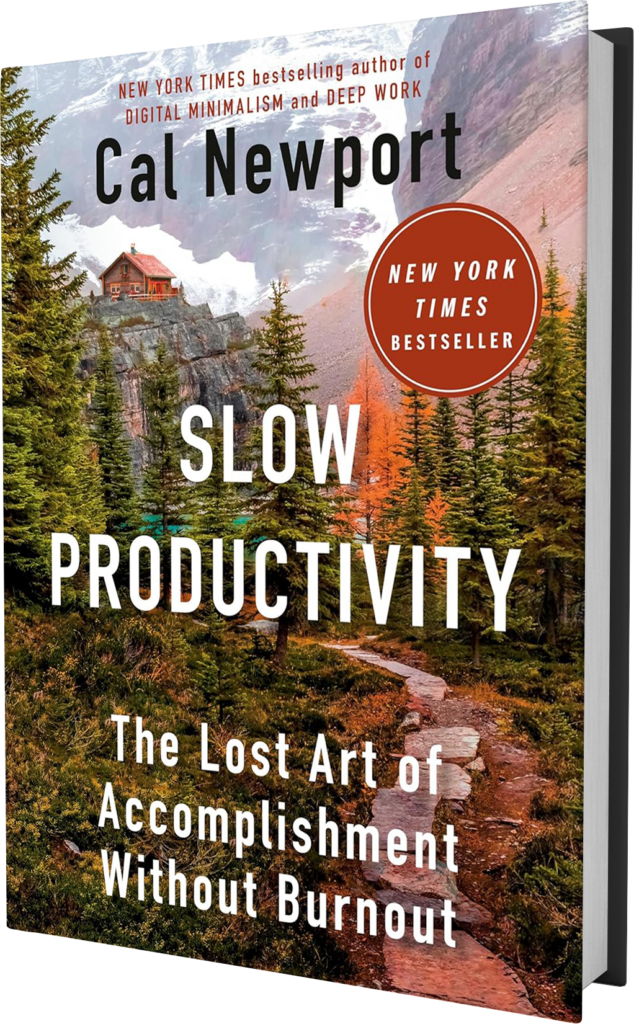
I’ve always had a keen interest in productivity. Starting out with getting things done (GTD) and also plans, progress, and problems (PPP) reports. And then I just happened across Slow Productivity by Cal Newport.

Cal talks about pseudo-productivity that is basically a focus on busyness. I learnt from an early age that busy is failure to prioritze. Slow productivity is about how to focus and execute on the right things by following three simple principles:

  1. Do fewer things
  2. Work at your own pace
  3. Obsess over quality

The books gives many examples of key people that succeeded using slow productivity. From Isaac Newton to Alanis Morrisette (which I’m looking forward to seeing this August 2024).

If you’re an overworked knowledge worker it’s worth a read.

Enjoy!

Posted in Uncategorized | Leave a comment

AI Agent Builders

Google recently unveiled Vertex AI Agent Builder. This new tool allows for the creation of AI assistants. Despite hopes for a zero-code approach, technology proficiency remains essential. And just like Amazon, Microsoft, and IBM who are targeting enterprise users, Google’s Vertex needs experienced technical users to micromanage AI from design through to deployment.

AI Agent Builder

At the other extreme, something like launch lemonade is an AI agent builder for the everyday user.  Good enough to get something up and running, monetizing AI agents from the get-go. However, not powerful enough yet to develop truly differentiated, enterprise grade, products. 

Then you have those platforms that live somewhere between these two extremes. Rasa specializes in creative conversational AI agents with a strong emphasis on natural language understanding. While DataRobot is a platform embraced by data super heavyweights to enable users to create deployable autonomous predicative models.  And then there is the platform of experts, or POE.  This platform creates AI agents capable of decision making and task execution. 

In short, it’s a mixed bag but the message is clear.  AI Agents are on the rise.  I’m waiting to see just how human friendly GPT5 AI Agents are.

Posted in Uncategorized | Leave a comment